
The paperwork came before the urgency did
The question of moving Kivalina off its barrier island was formally in the record before the storms of the 2000s made it a news story. The Army Corps of Engineers produced an assessment in the mid-1990s, and that document sits at the head of a long chain of studies, environmental impact assessments, agency reviews and planning reports that has grown more voluminous with each decade — while the island has continued to narrow.
Kivalina occupies a low gravel spit between the Chukchi Sea to the west and a lagoon to the east, at the mouth of the Wulik River. The spit was never wide, and erosion has taken measurable amounts from both the ocean-facing shore and the lagoon shore. The U.S. Army Corps of Engineers has maintained a coastal erosion database tracking rates at Alaskan communities, and Kivalina appears in it as a community where erosion is categorised as imminently threatening. Each update to that database has reinforced rather than revised the finding.
The Immediate Action Workgroup, convened under the Alaska Division of Community and Regional Affairs, pulled together agency representatives to assess which communities faced the sharpest risk. Kivalina was consistently in the small cluster of communities — along with Newtok and Shishmaref — identified as requiring action soonest. The phrase used in successive reports is "imminently threatened," a term with a specific administrative meaning: it signals that protective works on the existing site are no longer considered a viable long-term option and that relocation should be planned.
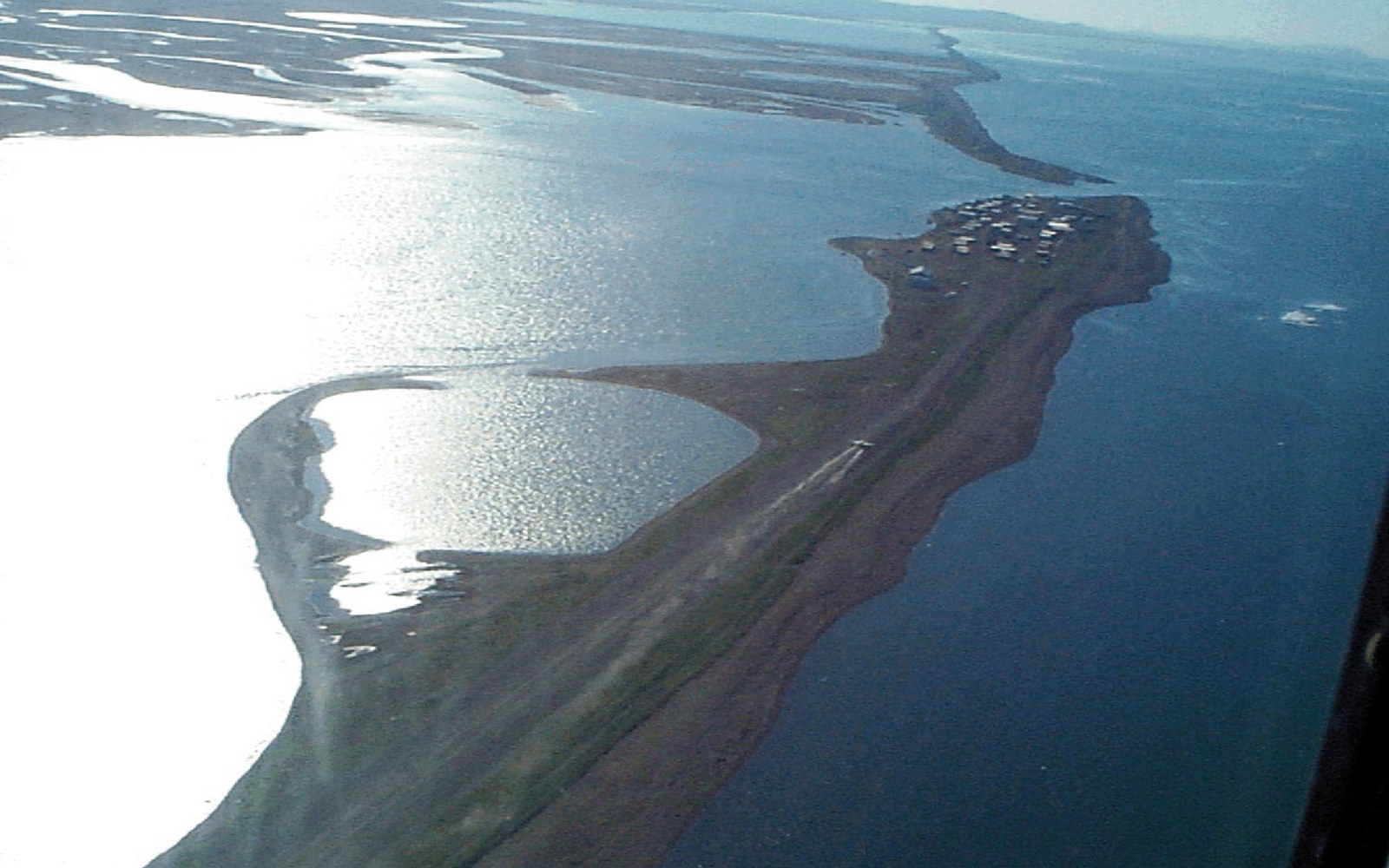
Kivalina sits on a barrier island between a lagoon and the Chukchi Sea, and the land available to it has been shrinking for decades. A village on a barrier island, and the island is narrowing
Photo: Kivalina Alaska aerial view · Wikimedia Commons
What the studies kept finding, and why finding alone was not enough
The Government Accountability Office report on Alaskan villages threatened by flooding and erosion identified Kivalina among approximately twelve communities facing imminent threats and estimated that relocation costs for communities in that situation ran into the tens of millions of dollars per community. That estimate, and subsequent ones, pointed immediately to the problem: no single federal agency had authority or budget to fund a village relocation. The Corps of Engineers could fund erosion-protection structures under certain programmes; the Department of Housing and Urban Development could fund housing; the Bureau of Indian Affairs had some infrastructure authority. But moving an entire community — roads, utilities, the school, the airstrip, the water and sanitation systems, and the housing — required a level of coordinated federal expenditure that existing programmes were not designed to deliver.
The Denali Commission, an independent federal agency created in 1998 to address infrastructure challenges in rural Alaska, conducted its own assessments and eventually produced reports specifically on managed community relocation. Its findings echoed the GAO's: the governance and funding gap was as large as the physical problem. The Commission's 2012 report on the topic laid out the mismatch in detail, describing a situation where multiple federal agencies shared jurisdiction without any single body holding both the responsibility and the resources to act.
Site selection proved a second complication independent of funding. Multiple candidate relocation sites for Kivalina were evaluated over the 2000s and into the 2010s. The preferred site, on higher ground inland to the southeast, required access across land with its own title complexities — land whose status was shaped in part by the Alaska Native Claims Settlement Act of 1971, which had extinguished aboriginal title and conveyed land to regional and village corporations rather than to municipalities. The ANCSA settlement meant that land tenure in the region ran through NANA Regional Corporation and the Kivalina village corporation, and any relocation site required agreements that involved those entities alongside federal and state agencies. Each layer of coordination added time.
The school acted as an additional constraint. In a community of roughly four hundred people, the school is the largest capital investment on the island, and the question of when to commit to building a new school at the relocation site rather than maintaining the existing one was both a financial and a logistical hinge point. Building a school at the new site before housing existed there made little operational sense; waiting to build it until relocation was underway meant that the school's replacement schedule and the relocation schedule had to be synchronised — a coordination problem that drew in the State of Alaska, the Northwest Arctic Borough School District and federal funders simultaneously.
What the studies did accomplish, cumulatively, is the construction of a detailed public record.
The record is the clearest account of why it has not happened
By the early 2010s the documentation trail included Corps assessments, GAO reports, Denali Commission analyses, state agency reviews, environmental impact studies for specific candidate sites, and planning documents produced by the community itself through the Kivalina Relocation Planning Committee, which had been tracking site options and cost estimates since the mid-2000s. The cumulative cost estimate in those later documents had grown to figures in the range of a hundred million dollars or more, depending on the scope and timeline assumed — a number that remained without an identified federal appropriation.
Meanwhile, protective measures on the existing site continued. Rock revetments were placed along the most exposed ocean-facing shore. These were characterised in agency documents not as a long-term solution but as a measure intended to extend the time available for planning and funding a relocation — a distinction the studies were careful to maintain. The revetments bought time; they did not change the underlying finding.
The stretch this piece is about: Kivalina at the mouth, Red Dog at the head, the De Long Mountains behind both.
Geometry: project map kit
The pattern that emerges from the full documentary record is specific: each study confirmed the previous study's findings, added detail on costs and site conditions, and identified the same structural gap in federal authority and funding. No report found that relocation was unnecessary or that the site was stable. The disagreement in the record is not about whether to move but about which site, at what cost, under whose authority, and with which funding mechanism. Those questions have not been answered by the weight of the studies, because they are ultimately appropriations and governance questions, not engineering ones.
What the studies did accomplish, cumulatively, is the construction of a detailed public record. The erosion measurements, the site assessments, the cost estimates and the funding-gap analyses are all in that record, dated and sourced. Anyone asking why Kivalina has not moved has access to a paper trail that answers the question precisely — not with a single cause but with a documented accumulation of institutional constraints, each one individually tractable and collectively, so far, not resolved.