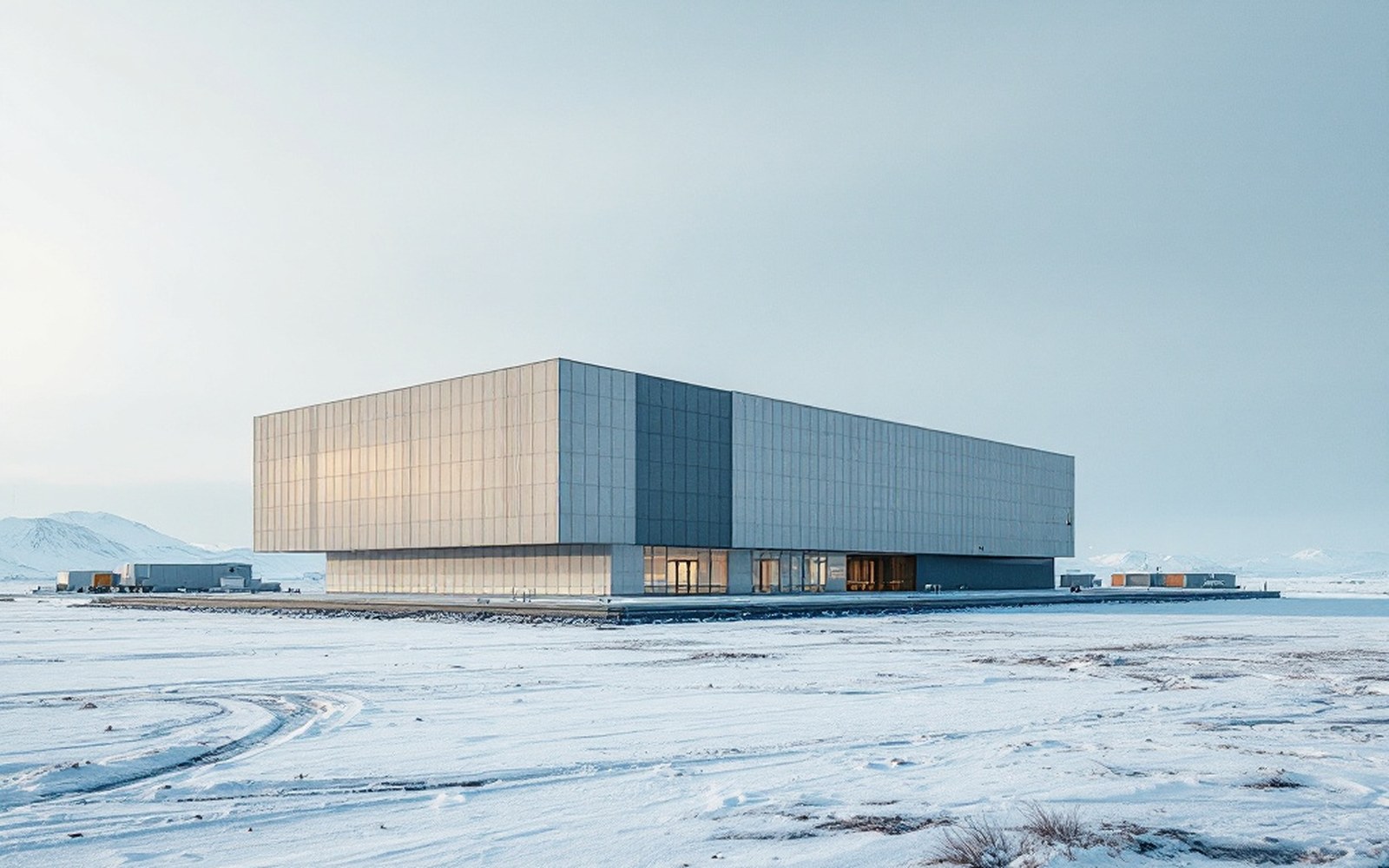
The School as Infrastructure Anchor
Kivalina's school, operated by Northwest Arctic Borough School District, is not simply where children are educated. It is the largest enclosed structure in the community, the most expensive fixed asset, and the building that anchors every other service decision — which direction the water and sewer lines run, where housing clusters, where the road stops. In a village of roughly five hundred people on a barrier island between a lagoon and the Chukchi Sea, one building at that scale sets the geometry of everything around it.
The current school was constructed on the island and has been subject to the same erosion and storm-surge exposure that has made Kivalina's situation the subject of federal and state studies since at least the 1990s. The Northwest Arctic Borough School District serves communities across a vast roadless region, and the capital cost of a school building — typically in the tens of millions of dollars for a facility this remote, where every material arrives by barge or air — means it cannot simply be moved when conditions deteriorate. The building becomes, in effect, a bet on a location.
The Siting Problem
The relocation debate that has surrounded Kivalina for decades is, at its operational core, a question about where to put the next school. Multiple agency and engineering studies have examined candidate sites on the mainland across Kivalina Lagoon, and each evaluation has had to weigh the same variables: elevation above projected flood levels, load-bearing ground, distance from the existing community, and access by water and potentially by a future road. Thawing permafrost eliminates candidate sites that look flat and stable on a map but cannot bear foundation loads across seasonal cycles.
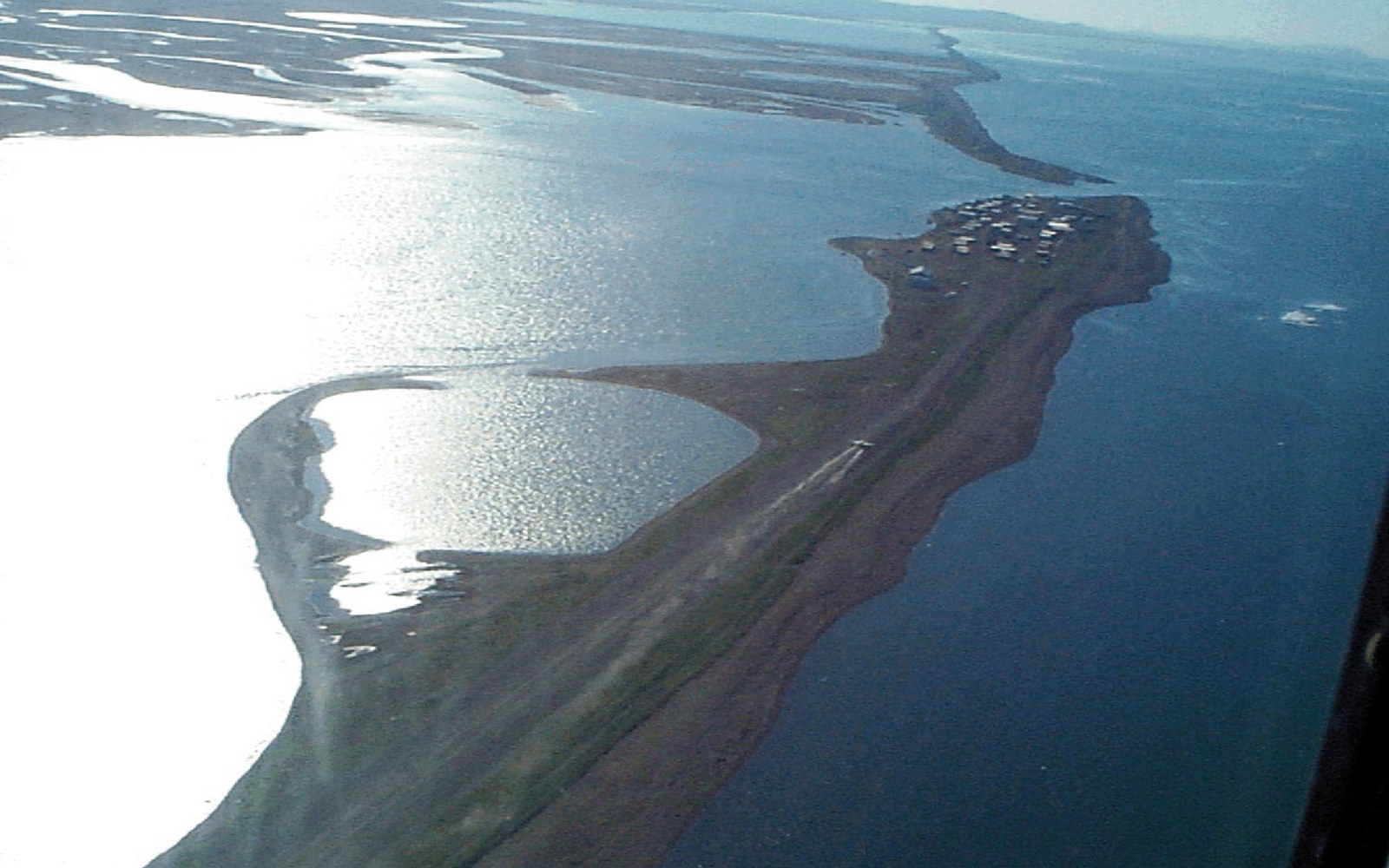
Kivalina sits on a barrier island between a lagoon and the Chukchi Sea, and the land available to it has been shrinking for decades. A village on a barrier island, and the island is narrowing
Photo: Kivalina Alaska aerial view · Wikimedia Commons
The U.S. Army Corps of Engineers has conducted assessments of Kivalina's erosion exposure, and the documented erosion rates along this coast run to several metres per year in the worst stretches. Those figures are not background context for the relocation discussion — they are the mechanism forcing it. When storm-season waves now reach infrastructure that shorefast ice once shielded, the question of where to build the next generation of permanent structures becomes urgent rather than theoretical, and the school is the test case because it is the largest one.
Any new school built on a mainland site would effectively transfer the community's institutional gravity to that location. Housing, the health clinic, the washeteria, fuel storage — each of these follows the school rather than leads it, because no other single facility concentrates the daily movement of the whole population the same way. The relocation studies that have accumulated since the 1990s all grapple with this: you cannot relocate a community incrementally if the school stays behind, and you cannot relocate the school without the capital commitment that makes everything else follow.
Funding and Decision Authority
School construction in rural Alaska is funded through the Alaska Department of Education and Early Development's major maintenance and new construction program, which scores projects on need and ranks them for legislative appropriation. A new school at a relocated Kivalina site would require a capital appropriation from the Alaska Legislature, a site selected and approved through borough and state processes, and environmental review. The Northwest Arctic Borough School District is the local authority, but the capital decision is a state one, and the state decision is also a land decision — the new site would need to be identified, surveyed and conveyed through processes involving NANA Regional Corporation as the regional landowner and the federal and state agencies with jurisdiction over adjacent lands.
This is why the physical move of a village cannot be separated from the administrative history that governs land in the region. ANCSA conveyed land to corporations, not to municipalities, which means the ground under a future school is held under a different legal framework than the services the school delivers. Resolving that is not an engineering problem. It is a transaction, and it takes longer than the erosion does.