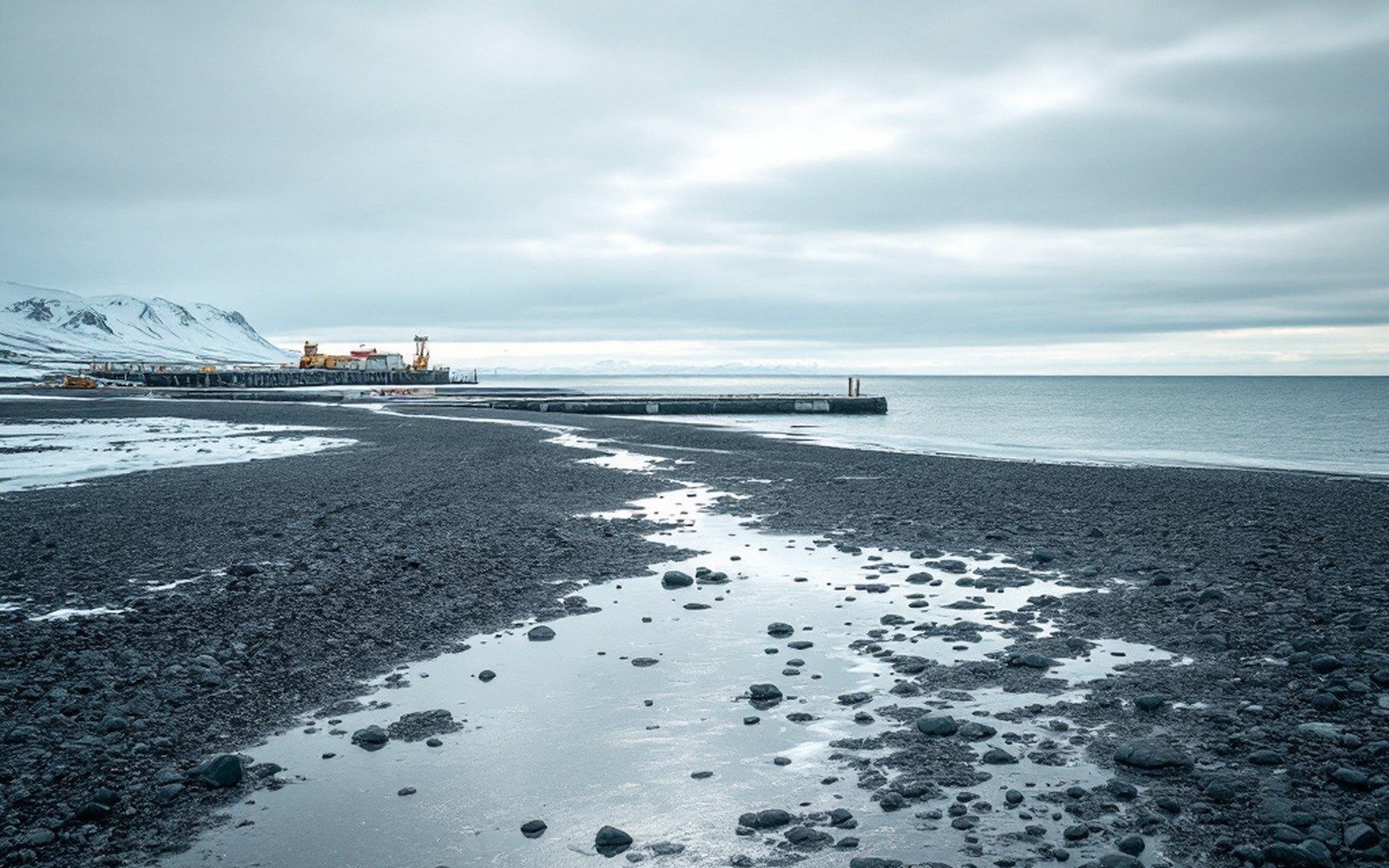
The depth problem that no berth can solve
The Chukchi Sea coast at the mouth of the Wulik River is not a place that wants to be a port. The water is shallow for a long way out, the seabed grades gently toward deeper water, and there is nothing resembling a natural harbour within reach. Red Dog Mine produces well over a million tonnes of zinc and lead concentrate each year, and every tonne of it must cross that coast and reach a bulk carrier anchored well beyond where the water gets deep enough to float one. The solution is lightering — transferring cargo from small, shallow-draft vessels that can work close to shore out to the larger ships waiting offshore — and it defines everything about how the mine's output reaches the world.
The mine's concentrate travels first by road. The DeLong Mountain Transportation System — a privately built, gravel-surfaced haul road roughly 52 miles long — runs from the mine to a purpose-built port facility on the coast. That facility, formally called the DMTS port site, sits near Cape Krusenstern, north of Kivalina, on land owned by the NANA Regional Corporation. The road, the port site and the marine transfer operation were all built specifically to move Red Dog's concentrate, and none of it would exist if the shallow coast had permitted an orthodox deep-water terminal.
Lightering: mechanics of an offshore transfer
At the port site, concentrate is unloaded from haul trucks and stored in a large shed designed to handle a year's-worth of production in stages. When a ship arrives and anchors offshore — typically in eight to twelve fathoms of water, depending on vessel size and sea conditions — the operation begins moving the stored material in the other direction. Front-end loaders push concentrate into a reclaim tunnel beneath the storage building, and a conveyor carries it out along a causeway and onto a small fleet of self-propelled barges. Those barges, with shallow drafts suited to the inshore waters, ferry loaded concentrate out to the anchored vessel, where a ship-mounted crane or the vessel's own gear brings the material aboard.
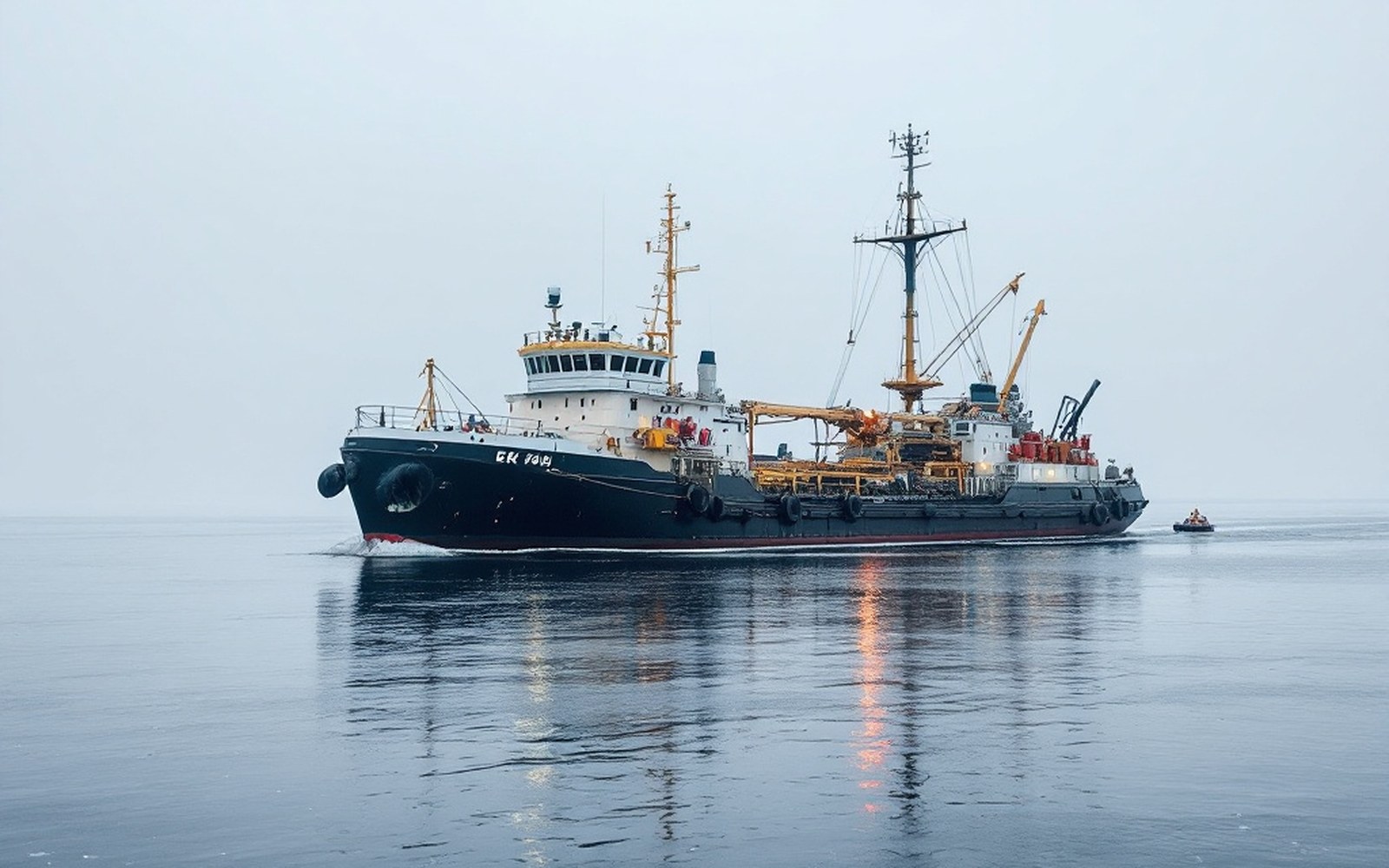
Ice closes the coast for most of the year, so a year's production moves in one short open-water window. The shipping season is about a hundred days
The barges return empty and the cycle repeats. It is slow by the standards of a conventional bulk terminal, where a ship ties up and a loader fills it at a continuous rate, and the weather window available at any given moment can interrupt or halt the process at any stage. Swells, wind and fog are not abstractions here — they determine whether a transfer can proceed, and they do not consult a production schedule. The operation is explicitly designed around this variability: the storage building holds enough material to buffer production through weather delays and to front-load the shipping season's early calls.
The window and what it constrains
Because the Chukchi Sea is ice-covered for most of the year, the entire marine operation compresses into a shipping season that typically runs from late July through October — roughly one hundred days in a good year, sometimes fewer. In that window, the mine must move the full year's concentrate production, plus whatever has accumulated. Ships arrive in sequence, anchor, load by lighter and depart. The timing of first call and last call is dictated by ice conditions, which in practice means they are dictated by the previous winter's ice extent, the current summer's melt rate, and the prevailing winds in a given August or September.
The shallow coastal bathymetry that prevents deep-water berthing also limits how large a barge can work the transfer efficiently, which in turn limits how fast each ship can be loaded. A Panamax bulk carrier at anchor waiting for barge cycles is a sizeable operating cost sitting idle in open water, and the offshore anchorage is exposed — if weather deteriorates quickly, the ship may need to move. This is not a hypothetical: the operating record at the DMTS port site includes seasons where storms interrupted lightering operations and extended the time a vessel needed to complete loading.
Who owns the ground
The land the port facility sits on is held by NANA under the Alaska Native Claims Settlement Act, the 1971 federal legislation that extinguished aboriginal title across Alaska and conveyed land and capital to newly created regional and village corporations. NANA's ownership of the surface estate is the legal foundation for both the road and the port. The operating agreement between NANA and Teck Alaska Incorporated — the mine operator — is what makes the arrangement work commercially: NANA receives royalties on concentrate shipped, and those royalties are tied to throughput, meaning the volume that successfully crosses that shallow coast to a waiting ship.
In that window, the mine must move the full year's concentrate production, plus whatever has accumulated.
The port site itself has no community, no permanent population, and almost no infrastructure beyond what the operation requires. It exists because the mine exists, and its engineering choices follow directly from the geography: a coast with no deep water and no harbour meant that the only practicable design was one built around offshore transfer rather than ship-to-shore contact.
Engineering a limitation into the system
There have been assessments over the years of whether a deeper-water facility could be created — dredging, a causeway extension, a different alignment — but the scale of capital required to materially change the bathymetry, combined with the limited season and the remoteness of the site, has meant the lightering model has persisted since the mine opened in 1989. The DMTS port facility has been incrementally improved: the storage building was expanded, the causeway modified, the barge fleet managed for reliability in a place where spare parts arrive by air. But the fundamental geometry — mine to road, road to coast, coast to barge, barge to ship — has not changed.
What the system does is move roughly half a million tonnes of metal concentrate across open water in about one hundred days every year, using small vessels to bridge the gap that the seabed imposes between the shore and the ships. In a port geography that offers nothing easy, that is the durable answer: not a harbour, but an operation built around the absence of one.